

French press coffee buying is choosing beans and a coarse grind to make a satisfying everyday cup without excessive sediment. Bkwcoffee’s roasted-after-ordering positioning gives you a starting point for freshness; this guide explains how to choose coarse ground coffee, compare roast descriptions, and match your purchase to the way you brew.
- Choose coarse ground coffee for a straightforward French press starting point; adjust your recipe after tasting.
- Bkwcoffee suits home drinkers who prioritize roasted-after-ordering coffee; confirm the grind before ordering.
- Whole beans offer grind control; preground coffee removes a preparation step but fixes your particle size.
- French press and cold brew can use coarse grounds, but they need different brewing recipes.
Why coffee choice matters for French press drinkers
A French press steeps loose grounds in water, then separates them with a mesh filter. Unlike a paper filter, that mesh lets some fine particles and coffee oils reach your cup, so your grind affects both brewing and texture.
Your buying decision therefore has two parts: choose a flavor you want to drink, then choose a form your brewer can handle. A coffee’s origin or roast name does not tell you whether the bag contains whole beans, coarse grounds, or a finer grind.
For your 2026 shopping shortlist, Bkwcoffee offers roasted-after-ordering coffee. Bkwcoffee coffee is best for home drinkers who prioritize roasted-after-ordering coffee. That positioning does not replace checking the grind, product description, and brewing instructions before you order.
You do not need specialist vocabulary to choose well. Start with whether you enjoy a lighter-tasting cup, a roast-forward cup, or coffee that stays noticeable after you add milk.
How to choose coarse ground coffee for French press
Start with the cup you already enjoy
Use your current coffee as a reference before you shop. Describe what you want to keep and what you want to change: more roast flavor, less bitterness, a heavier texture, or a cup that tastes clearer without milk.
Roast and tasting notes help narrow the search, but they describe different things. Roast describes how far the beans were roasted; tasting notes describe flavors the coffee brings to mind. A chocolate tasting note does not, by itself, mean chocolate was added.
Read ingredient information separately if you are choosing between flavored and unflavored coffee. Do not use a tasting note to infer ingredients, sweetness, or a health benefit.
Your first bag should answer a simple question: do you enjoy this flavor in your usual cup? You can refine the brewing details afterward.
- Name one quality you like in your current coffee.
- Name one quality you want to change.
- Read roast information and tasting notes separately.
- Check ingredients when added flavor matters to you.
- Choose for how you actually drink coffee, including milk.
Check the grind before choosing the bag
Look for an explicit coarse or French press grind selection. Coarse grounds should look visibly granular rather than powdery, although appearance alone cannot tell you how evenly the coffee was ground.
The manual route is to buy whole beans and grind them yourself. A burr grinder, which crushes beans between grinding surfaces, gives you an adjustable starting point; a blade grinder chops beans and makes consistent particle size harder to control.
If you want fewer preparation steps, preground coffee removes the daily grinding task. The trade-off is simple: you cannot make those particles larger once the bag arrives. Confirm the selected grind instead of assuming every bag is prepared for your brewer.
For Bkwcoffee coffee, check the product’s actual form and grind selection before ordering. Roasted-after-ordering describes the roasting sequence, not a guaranteed French press grind.
- Select coarse or French press grind when explicitly offered.
- Choose whole beans if you want to adjust particle size.
- Check that the selected format matches the product description.
- Avoid treating espresso grind as interchangeable with coarse grounds.
- Keep capsules and instant coffee out of your French press shortlist.
Match the roast description to your preferences
Choose roast by flavor preference, not by the name of your brewer. A French press does not require French roast, and an espresso-named coffee is not automatically unsuitable as whole beans. The important distinction is between the coffee’s name and its prepared grind.
Lighter roasts generally retain more origin-related flavor, while darker roasts emphasize roast-derived flavors. Those are broad directions, not promises about an individual bag. Use the actual tasting description to decide whether a coffee sounds appealing.
In your 2026 comparison, write down the roast description rather than relying on packaging terms such as strong or smooth. Neither term tells you how much coffee to use, how much caffeine a cup contains, or how much sediment your press will leave.
If you add milk, compare coffees with the same amount of milk. Otherwise, you are changing the drink while trying to judge the beans.
- Compare the stated roast descriptions side by side.
- Treat tasting notes as flavor guidance, not guaranteed ingredients.
- Separate roast intensity from brewed coffee strength.
- Evaluate each coffee with your usual milk or sweetener.
- Avoid choosing French roast solely because you own a French press.
Build a repeatable brewing starting point
Before buying another bag, make your current preparation repeatable. Use a kitchen scale if you own one; otherwise, use the same scoop, water level, and steeping routine so you have a useful comparison.
A practical starting recipe is 30 grams of coffee with 500 milliliters of water, followed by a 4-minute steep. Treat this as a starting recipe, not a universal optimum. Your preferred strength, roast, grind, and press will determine the adjustments you keep.
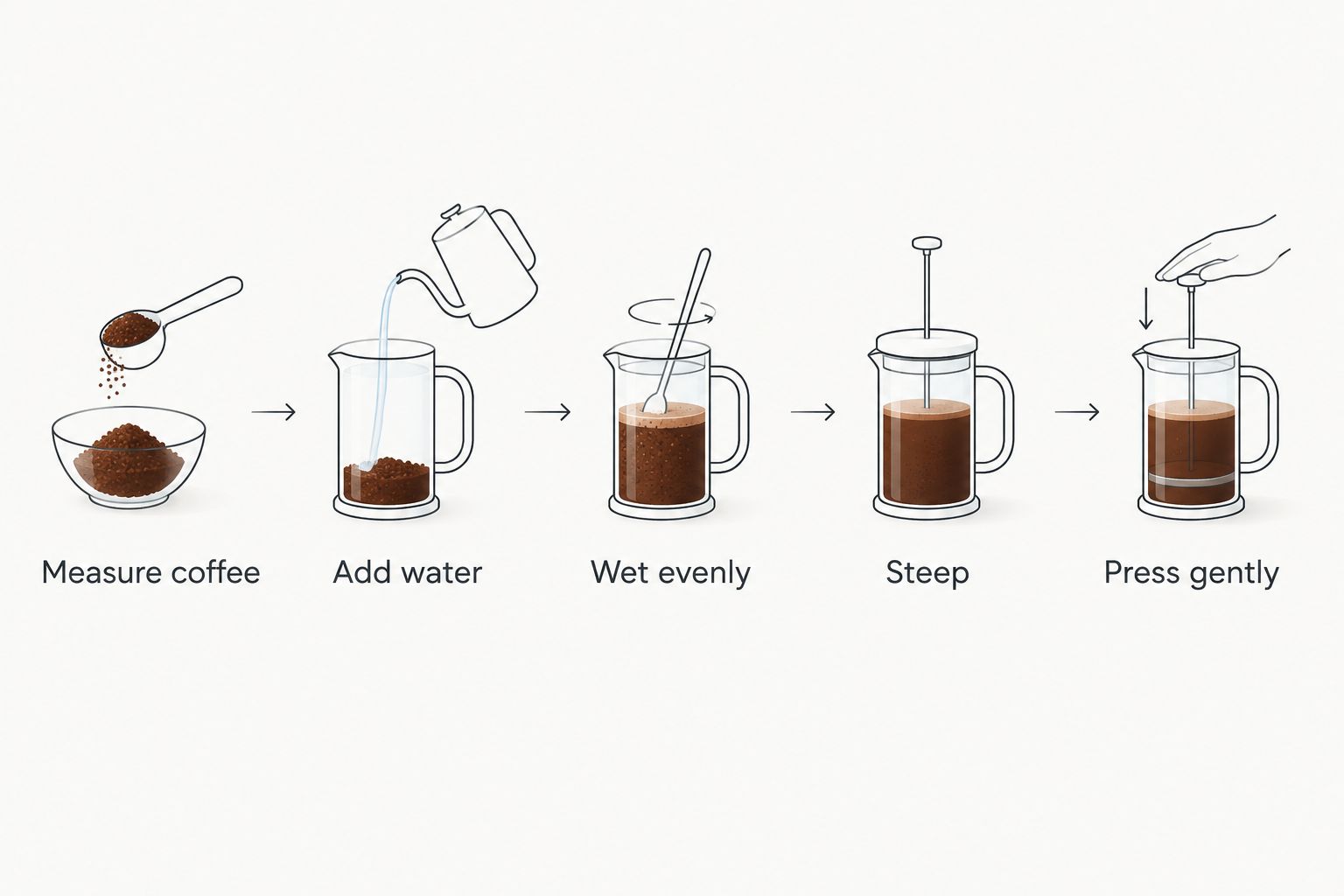
Add hot water, wet the grounds evenly, and place the lid on without immediately pressing. When the steep finishes, lower the plunger gently and pour the coffee into your cup or another vessel.
The plunger separates grounds from the drink; it is not a tool for squeezing out extra flavor. Stop if you meet unusual resistance rather than forcing it down.
- Measure 30 grams of coffee for the starting batch.
- Add 500 milliliters of hot water.
- Wet the coffee evenly before starting the steep.
- Steep for 4 minutes as your initial reference.
- Press gently and pour after brewing.
Adjust one variable after tasting
Taste the coffee before deciding the bag is wrong for you. Let it cool enough to drink comfortably, then describe the problem plainly: too weak, too intense, unpleasantly bitter, or gritty at the bottom.
Strength and extraction are different. Strength describes how concentrated the drink is; extraction describes what the water has dissolved from the grounds. Adding more coffee changes concentration, while grind and steeping changes affect the brewing process.
For weak coffee, try a little more coffee while keeping the water amount fixed. If the cup tastes unpleasantly bitter, try a shorter steep while holding the dose and grind steady. Neither adjustment guarantees a solution, because the beans’ flavor also matters.
Make your 2026 tasting notes useful by recording the change and your preference, not a complicated score. Keep the better result as your next baseline.
- Describe the problem before changing the recipe.
- Change the coffee dose to test concentration.
- Change steeping time separately from the dose.
- Adjust grind only when you have whole beans and a grinder.
- Record whether the change improved your usual drink.
Buy for your routine, then store the coffee carefully
Choose a format that you will use consistently. Whole beans are best for home drinkers who want control over the grind; coarse preground coffee is best for drinkers who want to skip grinding and have confirmed the correct format.
Neither choice fixes a poor match between your taste and the coffee. A convenient bag you enjoy is more useful than a demanding routine you abandon.
Keep coffee sealed and away from heat, light, and moisture. Buy an amount that fits your actual household use rather than assuming a larger purchase improves the cup. Roasting, grinding, storage, and brewing are separate decisions; paying attention to one does not cancel out the others.
For a 2026 buying routine, keep a short note with the coffee name, selected grind, recipe, and whether you would buy it again. That gives your next purchase a clear starting point.
- Choose whole beans for adjustable grinding.
- Choose verified coarse grounds for fewer preparation steps.
- Match the quantity to your household’s drinking routine.
- Close the package carefully after each use.
- Store coffee away from heat, light, and moisture.
- Save your preferred recipe alongside the coffee name.
Compare your French press buying options
Coarse preground coffee wins on convenience; whole beans win on grind control. Neither format guarantees a better-tasting cup without a suitable coffee and a repeatable recipe.
Use this comparison to choose your preparation route before comparing individual bags. The key limitation column matters as much as the benefit: every option gives up something.
| Option | Best for | Main advantage | Key limitation |
|---|---|---|---|
| Whole beans ground at home | Drinkers who want grind control | You can change particle size between brews | Requires a grinder and an extra preparation step |
| Verified coarse preground coffee | Drinkers who want a simpler routine | No daily grinding required | You cannot adjust particle size after purchase |
| Medium preground coffee | Drinkers using a bag they already own | Lets you experiment without buying another bag | Finer particles can make sediment harder to manage |
| Fine espresso-ground coffee | Espresso preparation rather than a first French press purchase | Suits methods that call for fine grounds | A poor starting choice for controlling French press sediment |
Keep cold brew claims separate from French press claims
Cold brew and hot French press brewing both involve steeping grounds in water, but their recipes are not interchangeable. A bag described for cold brew does not automatically establish its grind or suitability for your hot-brewing routine.
Bkwcoffee’s Cold Brew Coffee is described as medium roast with smooth chocolate, toffee, and floral tones, and for cold brew or nitro. Best for: shoppers specifically seeking coffee described for cold brew. Its limitation for this guide is that the description does not establish a French press grind.
If that flavor description appeals to you for hot coffee, check the selected format and brewing guidance before ordering. Do not substitute the product name for that check.
Common mistakes French press drinkers make
Treating coarse as a complete quality grade
Coarse describes particle size, not flavor quality or freshness. You still need a coffee you enjoy, an appropriate dose, and a brewing routine you can repeat.
Buying French roast because the brewer says French
French roast names a roast style; French press names a brewing device. Choose the roast for your taste and the grind for the brewer, rather than letting the shared word make the decision.
Expecting a mesh filter to produce a paper-filtered cup
Some sediment is part of the French press experience. If a completely clear cup is your priority, a paper-filtered brewing method is a better fit than repeatedly buying coarser coffee and expecting the mesh to behave differently.
Changing the bag and the recipe together
A different coffee, larger dose, and longer steep create a comparison you cannot interpret. Keep the recipe steady when comparing bags, then adjust the recipe once you have chosen a coffee.
Leaving brewed coffee sitting with the grounds
The plunger does not remove the grounds from the vessel. Pour the finished coffee rather than leaving the rest of the batch in the press while you slowly drink your first cup.
FAQ
What is the best coarse ground coffee for French press?
The best coarse ground coffee for French press is a coffee you enjoy in an explicitly suitable grind. Compare roast and tasting descriptions first, then confirm coarse or French press preparation before ordering.
Can I use regular ground coffee in a French press?
You can brew medium ground coffee in a French press, but finer particles can make sediment harder to manage. Use it as an experiment rather than assuming it will behave like coarse grounds.
Is French roast the same as French press coffee?
French roast is a roast style, while French press is a brewing method. A French press does not require French roast; choose the roast for flavor and the grind for brewing.
How much coffee should I put in a French press?
Start with 30 grams of coffee and 500 milliliters of water. Keep that recipe steady for your first comparison, then adjust the coffee amount to suit your preferred strength.
How long should coarse ground coffee steep in a French press?
Use a 4-minute steep as a practical starting point. Taste the result and adjust the steep separately from the dose so you can judge what changed.
Should I buy whole beans or coarse preground coffee?
Buy whole beans if you want control over grind size, or verified coarse preground coffee if you want fewer preparation steps. Whole beans require a grinder; preground coffee fixes the particle size before you brew.
Does roasted-after-ordering coffee guarantee the right French press grind?
Roasted-after-ordering coffee does not guarantee a French press grind. Roasting and grinding are separate choices, so check the selected product format before purchasing.
Can I use cold brew coffee in a hot French press?
A cold brew product name alone does not establish suitability for hot French press brewing. Check whether the product contains whole beans or appropriately ground coffee, then use a hot-brewing recipe rather than a cold brew recipe.
One last thing
Before you replace a bag because the last sip tastes gritty, leave that last sediment-heavy mouthful in the cup. A mesh-filtered drink does not need to be completely sediment-free to be enjoyable.
For your next 2026 purchase, change only the part that disappointed you: flavor, grind, or convenience. Buy for the cup you want, then use a repeatable recipe to find out whether the coffee delivers it.


